







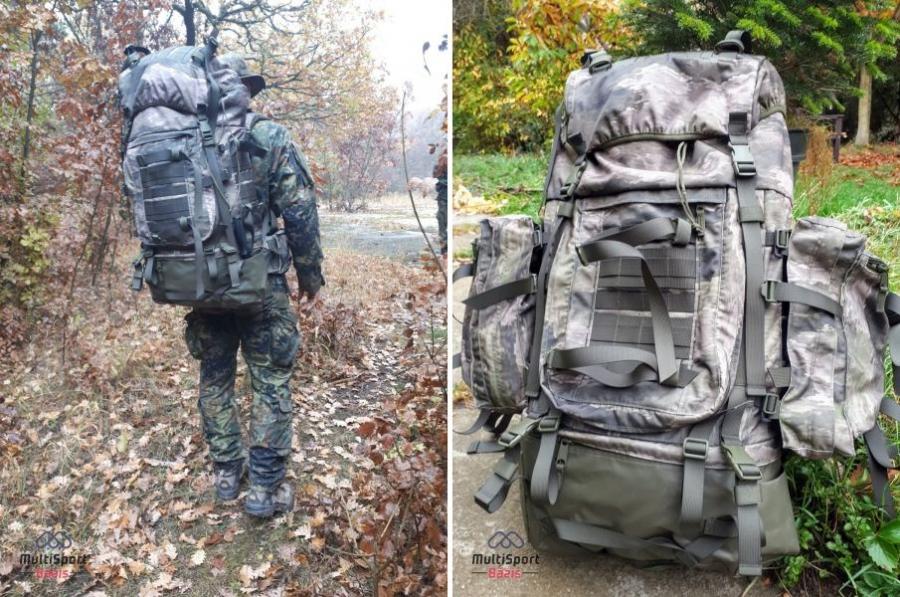
Once you take it out of the packaging, the first thing you notice is the size – no surprise there, since we’re talking about a 100-liter pack that is designed for extreme use. It’s big. Oh yes.
When you lift it out of the box, you’re pleasantly surprised to find that despite this, it’s light. It’s just over 3 kg (my own home measurement was 3.35 kg)! Online you’ll find weight data between 2.7 and 4 kg, so it’s possible there are differences, but this pack definitely cannot be under 3 kg. It’s true that a normal 80-liter trekking pack is around 2.5 kg, but let’s see what extras we get for this additional weight (which, let’s be honest, isn’t that much…).
The Mil-Tec Teesar 100 backpack was designed by people who regularly take part in extreme hikes and/or military operations. Critical areas are reinforced, secondary areas are lightened. The suspension is clearly and tangibly designed so you can carry 40–50 kg of gear comfortably and over long distances. It’s full of practical solutions, all of which serve the purpose of letting you pack and unpack quickly, and access gear in seconds even on the move.

The test started with me loading it up with 39 kg (a 20 L jerry can of water, clothes, canned food, tent, …) so I could quickly check how it fills out and how easily it can be adjusted. This weight could be lifted comfortably and very easily using the grab handles, and I could tailor the carrying system to my body in no time – I could literally have set off straight away.
But we had to wait a few days for that, until we set off on a 3-day bush hike. Even in this case (early November, sleeping outdoors, preparing for rain, carrying all our food) there was no need for the side pockets, so I removed them.
A few words about the Teesar 100 side attachment options, even though I didn’t use them in the field (everything simply fit into the main pack). The pockets attach to the pack with a practical and easy-to-use system (which is also easy to repair if damaged), allowing for quick swapping. Underneath them, on the sides and front of the pack, you’ll find webbing for the MOLLE system (in military jargon MOLLE stands for “Modular Lightweight Load-carrying Equipment” – that is, a modular load-carrying system with easily interchangeable gear). You can attach pretty much anything here if needed.

The side pockets are made of lightweight ripstop material with strong two-way zippers, which is very practical for packing. On top of that, there’s an extra small pocket on the side of each for small items. Due to the lightweight fabric, the pockets have no real structure, so it’s not worth putting large, heavy items in them – but basic packing rules for gear placement wouldn’t recommend that anyway.
Let’s look at the practical experiences with the Mil-Tec Teesar 100 backpack!

It’s no surprise that the buckles, straps and materials are of outstandingly high quality. Everything is where it should be, everything is well thought out. The inner opening for the water reservoir can be closed, the drinking tube can be routed in several ways, and it has its own dedicated buckle and webbing. The 3-liter reservoir is easy and simple to remove even from a fully packed backpack, and its position is simply perfect. External mounting of a reservoir is also an option (using the MOLE system), depending on how you prefer it.

It’s unusual that one of the pockets on the top of the pack opens to the side, with a two-way zipper. It works well, although smaller items can “hide” in the far corner. On the upside, nothing falls out, even if it accidentally remains open. The upper large pocket houses the extra rain cover. It’s practical and protects the pack very well. For me, a minor drawback is that the rain cover almost completely fills this pocket, so you can barely put anything else into this otherwise frequently used spot.
You can access the main compartment in three ways: via the classic top opening with straps, the usual bottom zipper opening found on large packs, and a very rare middle, also zippered opening. Inside the compartment there are three divider flaps that can be closed as needed.
The top opening is classic, closed with a drawcord, and the pack lid has strong and stable attachment points for closing (though you can still easily stuff a jacket, firewood, branches, climbing rope, etc. between the two…). The middle compartment can also be accessed through a huge opening on the front of the pack. There is also a small document pocket on this panel. If we pack thoughtfully, this pocket can become the perfect emergency entrance through which we can reach almost all our gear when we quickly need something.
There are also MOLLE straps on this front flap – if you strap something on here, opening it might be problematic (though I didn’t try this). It makes sense to pack smaller and lighter items here that you need quick access to. The bottom compartment is accessed via the usual large, two-way zipper.
Warning: it’s very easy to pack it poorly or overpack it! This is perhaps its only real drawback – it doesn’t force you to think through your gear distribution. Yet in this case, it is still very important what you put where, how you access it, and where you place the center of gravity.
If you don’t make mistakes here, you’ll feel fantastic in the field with the Mil-Tec Teesar 100 backpack!
Technical matrix summary 4.1
|
Weight |
4 |
the 3.5 kg empty weight is fully acceptable given the size and material quality |
|||||
|
Material |
5 |
strong, well-designed materials, properly used in all areas |
|||||
|
Handling |
5 | ||||||
|
Suspension |
4 |
strong and comfortable, can be well adjusted for all types of movement |
|||||
|
Top pocket |
3 |
the placement of the rain cover could be better – one key storage area is effectively lost |
|||||
|
Middle compartments |
5 | ||||||
|
Side pockets |
3 |
practical and easy to handle, but if they are not full, they tend to flop around a bit |
|||||
|
Bottom compartment |
4 |
reinforced bottom, perfectly usable zipper, extra straps |
|||||
|
External attachments |
4 |
for a few of the straps, it would be nice if they were removable |
|||||
|
Rain cover |
4 |
works well, really protects against rain, but its placement is not ideal |
|||||
| Total score |
4.1 |